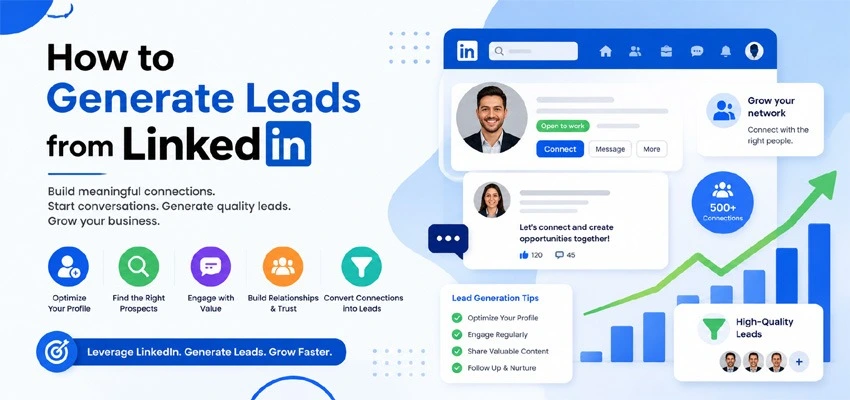
LinkedIn is not just a digital resume platform. With over one billion members worldwide and a user base made up predominantly of professionals, decision-makers, and business owners, it is the single most powerful social network for B2B lead generation available today.
Yet most people use LinkedIn passively — updating their profile occasionally, accepting connection requests, and scrolling through the feed without a clear strategy. That approach leaves enormous opportunity untapped.
The professionals and businesses that consistently generate leads from LinkedIn are doing something fundamentally different. They are showing up with intention, building real relationships, and positioning themselves as trusted authorities in their niche. This guide breaks down exactly how to do the same — from the ground up.
1. Optimize Your LinkedIn Profile as a Lead Generation Asset
Before you reach out to a single prospect or publish a single post, your profile needs to work for you. Think of it not as an online CV, but as a landing page — the first thing a potential lead sees when they click your name, and the deciding factor in whether they want to engage.
Start with your headline. Rather than listing your job title, use this prime real estate to communicate value. Instead of “Sales Manager at XYZ Company,” consider something like “Helping SaaS Founders Scale Revenue Through Outbound Sales Strategy.” This immediately tells visitors who you help and how.
Your banner image should reinforce your positioning — use it to display a tagline, a key result you have achieved for clients, or a compelling visual that reflects your brand.
The About section is where you build trust. Write in first person, lead with the problem you solve, and follow with social proof — results, testimonials, or notable clients. End with a clear call to action, such as inviting visitors to connect, book a call, or download a free resource.
Finally, ensure your experience section, featured section, and skills are all filled out with keywords your ideal clients would realistically search for. A complete, keyword-rich profile dramatically improves your visibility in LinkedIn search results.
2. Define and Identify Your Ideal Client Profile
Effective LinkedIn lead generation does not mean connecting with everyone. It means connecting with the right people — and that requires a precise definition of who your ideal client is before you begin.
Map out your Ideal Client Profile (ICP) using specifics: industry, company size, job title, geography, and the challenges they commonly face. The more clearly you define this, the more targeted and efficient your outreach will be.
LinkedIn’s native search filters make it possible to find people who match your ICP with remarkable precision. You can filter by location, current company, industry, job title, seniority level, and more. Save your searches, revisit them regularly, and build a steady pipeline of qualified prospects from the results.
If you are serious about lead generation at scale, LinkedIn Sales Navigator unlocks significantly more powerful filtering and prospecting capabilities — more on that shortly.
3. Build a Connection Strategy That Feels Human
The biggest mistake people make on LinkedIn is sending generic, transactional connection requests the moment they identify a prospect. Nothing kills a potential relationship faster than a cold pitch in the first message.
Instead, approach connection requests as the beginning of a conversation, not a sales transaction. Personalize every request with a brief note that references something specific — a post they wrote, a mutual connection, a recent company milestone, or a shared professional interest. This small effort signals that you are a real person and dramatically increases acceptance rates.
Once connected, resist the urge to pitch immediately. Lead with value. Comment thoughtfully on their posts, share a relevant article, or simply acknowledge something interesting from their profile. The goal in the first few interactions is to be remembered as someone worth knowing — not someone trying to sell something.
A good rule of thumb is the “value before ask” principle: give two or three meaningful interactions before making any kind of request. By the time you do reach out with a specific offer or proposal, there is already a foundation of familiarity and goodwill.
4. Use Content to Attract Inbound Leads
Outreach is powerful, but inbound lead generation — where prospects come to you — is even more efficient and scalable. The way to generate inbound leads on LinkedIn is through consistent, high-value content.
Publish posts that address the real problems your target audience faces. Share insights from your own experience, challenge common misconceptions in your industry, break down complex topics into practical advice, and document results you have achieved. This type of content demonstrates expertise in a way that a profile alone never can.
LinkedIn currently rewards content that generates conversation. Posts that ask genuine questions, share a polarizing opinion, or tell a compelling story tend to generate the most comments and reach. Engage with every comment you receive — both because it extends the post’s visibility in the algorithm and because commenters are often warm leads.
Article-length posts and LinkedIn newsletters are also highly effective for establishing authority. Unlike regular posts, LinkedIn articles are indexable by Google, giving your content a longer shelf life and a broader potential audience.
Aim to post consistently — three to five times per week is ideal for most professionals. The compound effect of regular content creation means that over time, your name becomes synonymous with your area of expertise in the minds of your target audience.
5. Leverage LinkedIn Sales Navigator for Precision Prospecting
For anyone serious about using LinkedIn as a lead generation engine, Sales Navigator is worth the investment. It provides advanced search filters, lead and account recommendations, real-time alerts on prospect activity, and the ability to save and organize leads into lists.
With Sales Navigator, you can set up alerts to notify you when a prospect changes jobs, gets promoted, or posts content — all of which are natural conversation starters. You can also filter prospects by whether they have been active on LinkedIn in the past 30 days, ensuring you are reaching out to people who are actually engaged on the platform.
The TeamLink feature shows you whether any of your colleagues are already connected to a prospect, enabling warm introductions. In competitive markets, a warm introduction can be the difference between a response and silence.
Use Sales Navigator in combination with a consistent outreach cadence. Track your conversations, note where each lead is in the relationship-building process, and follow up at the right moments rather than letting promising connections go cold.
6. Craft Outreach Messages That Get Replies
LinkedIn outreach messages succeed or fail based on how relevant and human they feel to the recipient. Most InMails and direct messages fail because they are too long, too generic, or open with a pitch rather than a connection.
The most effective outreach messages share four qualities: they are short (under 100 words when possible), they are personalized, they lead with something relevant to the recipient rather than the sender, and they end with a low-friction ask — such as a question or a request for a short call rather than a demand for time or attention.
Reference something specific about the person — a post they published, a challenge common in their industry, or a result their company recently achieved. Then bridge naturally to why you are reaching out and what value you can offer.
Avoid attachments, links, and lengthy descriptions in the first message. The goal of the first message is simply to start a conversation, not to close a deal.
A/B test your messaging regularly. Small changes in subject lines, opening sentences, and calls to action can produce significantly different response rates. Track what works and refine accordingly.
7. Run LinkedIn Ads to Amplify Your Reach
Organic strategies build relationships and credibility, but LinkedIn Ads allow you to reach highly specific audiences at scale — and generate leads with measurable ROI.
LinkedIn’s advertising platform offers unique targeting capabilities that no other network can match: job title, company size, industry, seniority, member skills, and even specific companies. This precision makes LinkedIn Ads especially effective for B2B businesses with a clearly defined target market.
Lead Gen Forms — LinkedIn’s native ad format designed for capturing leads — are particularly powerful. They pre-populate with the user’s LinkedIn profile data, reducing friction and dramatically increasing form completion rates compared to sending users to an external landing page.
Sponsored Content, Message Ads, and Dynamic Ads each serve different objectives. Sponsored Content builds awareness and drives engagement with your best-performing posts. Message Ads deliver personalized messages directly to a target audience’s inbox. Dynamic Ads use personalization — pulling in the user’s own profile picture and name — to capture attention in the sidebar.
Start with a modest budget, test multiple creatives and targeting combinations, and scale the campaigns that deliver the lowest cost per lead.
8. Follow Up Consistently and Nurture Relationships Over Time
The majority of LinkedIn leads do not convert on the first interaction — or even the third. Lead generation on LinkedIn is fundamentally a long game, and consistent, genuine follow-up is what separates the professionals who see real results from those who give up too early.
Build a simple follow-up system. Tag your connections, keep notes on conversations, and set reminders to check in periodically. Share a relevant article, congratulate them on a work anniversary, or comment on a post they have written. These small touchpoints keep you top of mind without feeling pushy.
Not every connection will become a client — and that is fine. Some will refer business your way. Some will become collaborators or partners. Every relationship has potential value if it is nurtured with patience and authenticity.
Conclusion
LinkedIn lead generation is not a shortcut — it is a system built on consistency, genuine value, and strategic relationship-building. When you combine a compelling profile, a targeted connection strategy, consistent content creation, smart outreach, and the right tools, LinkedIn becomes one of the most reliable and cost-effective sources of qualified leads available to any professional or business.
Start by fixing your profile. Then get clear on who you want to reach. Then show up every day and add value. The leads will follow.